

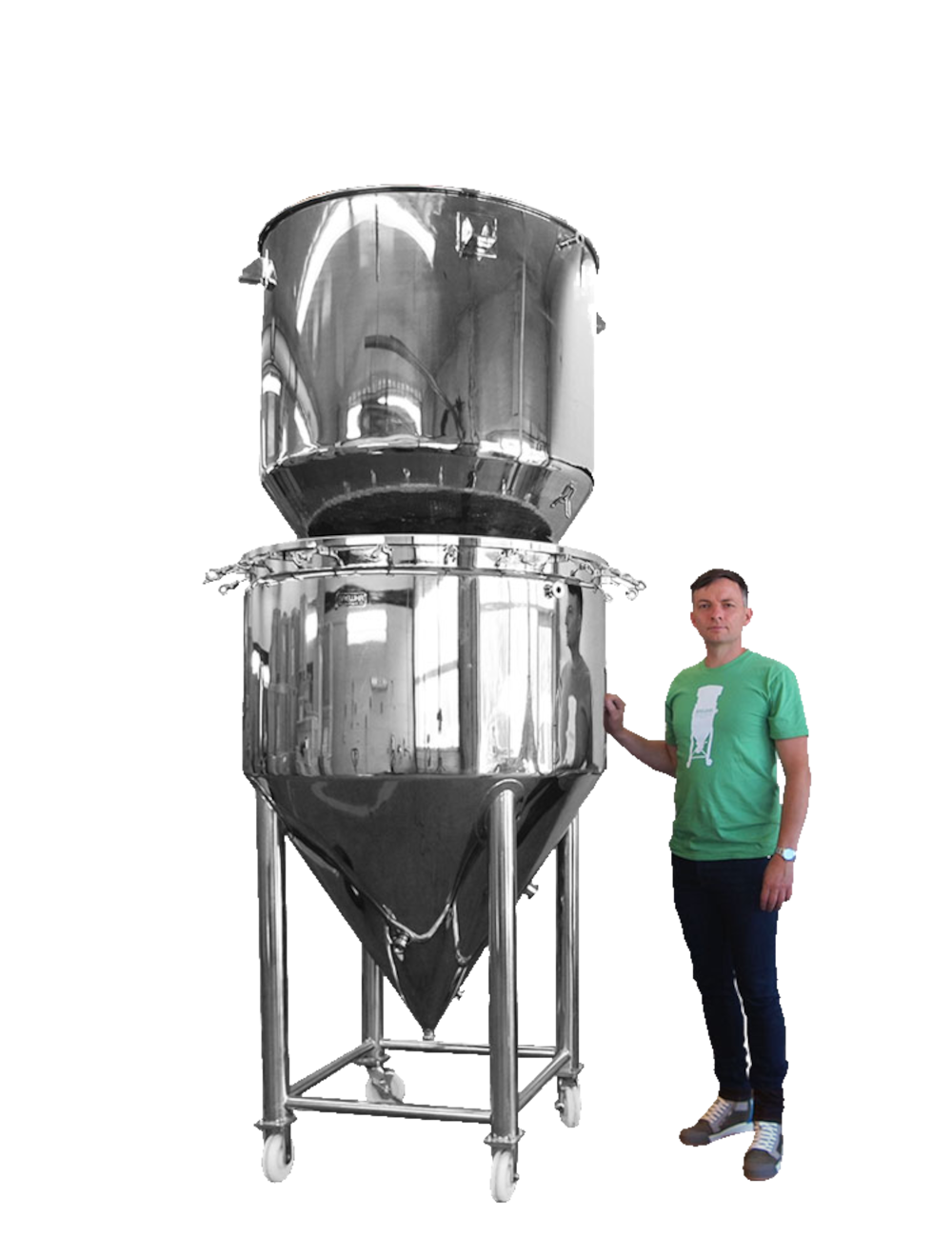
Build a compact commercial brewery around one versatile 5 BBL vessel.
The BREWHA BIAC® 5 BBL / 6 hL brewing system combines the functions of a mash tun, brew kettle, fermenter, conditioning tank and serving vessel in one jacketed, insulated stainless steel unitank. It is designed for brewpubs, taprooms, restaurants and small production breweries that want commercial brewing capacity with fewer dedicated vessels, fewer transfers and a smaller equipment footprint.
The system includes one brew-ready 5-in-1 Fermentor and the shared Mash Colander®, pump and power-control equipment required for the BIAC brewing process. After mashing, the Mash Colander can be lifted out and moved to another compatible BIAC Fermentor, allowing capacity to grow one vessel at a time without purchasing another complete brewhouse.
Why choose the BREWHA 5 BBL brewing system?
- Five process stages in one vessel: mash, boil, ferment, condition and serve in the same stainless steel unitank when appropriately configured.
- Compact commercial footprint: reduce the number of dedicated tanks and permanent process connections required by a conventional brewhouse and cellar.
- Fewer wort transfers: cool and ferment in the vessel used for boiling instead of transferring wort to a separate fermenter.
- Modular expansion: add compatible 5 BBL BIAC Fermentors while continuing to use the shared Mash Colander, pump and brewing controls.
- Electric operation: select the electrical configuration that matches the service planned for your brewery.
- Direct service capability: the pressure-rated Fermentor can support crashing, carbonation and direct service when installed and operated with the appropriate equipment.
Production capacity and expansion
With one included Fermentor and an approximately three-week tank cycle, the system can produce up to about 85 BBL per year, or roughly 20,000 US pints. Actual annual output depends on recipe volume, fermentation and conditioning time, cleaning schedule, staffing, utilities and operating practices.
To increase output, add another compatible 5 BBL stainless steel 5-in-1 Fermentor. The shared Mash Colander can move to the next vessel while the previous batch continues through boiling, fermentation, conditioning or service. This lets a brewery add tank capacity without duplicating all of the core brewing hardware.
Estimate the system capacity required for your production plan →
5 BBL / 6 hL brewhouse and fermenter specifications
- Maximum grain bill: 160 kg / 350 lb
- Maximum pre-boil volume: 680 L / 180 US gal
- Recommended beer volume: 360–590 L / approximately 3–5 BBL
- Gross tank volume: 720 L / 190 US gal
- Fermentor dimensions: 180 cm / 71 in high with lid removed; 110 cm / 43 in outside diameter
- Combined Fermentor and Mash Colander height: 284 cm / 112 in
- Recommended ceiling height: 391 cm / 154 in
- Minimum ceiling above the brewing-control area: 335 cm / 132 in when using an appropriate low-profile lifting arrangement
- Pressure rating: 14.9 psi vessel; 7 psi cooling jacket
- Approximate system mass: 590 kg / 1,300 lb
- Heating and pump load: 33 kW of electric heating plus a 1 hp pump
- 240 V single-phase configuration: approximately 145 A; two hot conductors, neutral and ground
- 208 V three-phase configuration: approximately 100 A; three hot conductors, neutral and ground
Important: Tank volumes shown above are gross or maximum volumes. Recommended batch volume varies by recipe and process requirements. Review the complete BIAC specifications before planning the building, utilities or production schedule.
How the BIAC 5-in-1 process works
- Mash: grain is held in the removable Mash Colander while wort circulates through the grain bed.
- Boil: the Mash Colander is lifted out and the wort is boiled in the Fermentor below.
- Cool and ferment: wort is cooled and fermented without a core transfer to a separate tank.
- Condition: compatible temperature and pressure controls support conditioning in the same vessel.
- Package or serve: finished beer can be transferred for packaging or, with an appropriate setup, carbonated and served directly from the vessel.
Watch how brewing works with the BIAC
Boil heat sanitizes the fermentation vessel
In a traditional brewery, cooled wort is transferred into a separate fermenter that must first be chemically sanitized. In the BIAC process, wort is boiled in the same vessel used for fermentation, so the heat of the boil sanitizes the Fermentor before the wort is cooled and yeast is pitched. This eliminates that separate chemical-sanitizing step associated with transferring wort into another fermenter. Normal cleaning to remove soil and residue is still required.
Plan the brewery before ordering
A commercial brewing system must be matched to the building as well as the production target. Before ordering, confirm the available voltage, phase and amperage; ceiling height and lifting arrangement; floor loading and drainage; water supply; ventilation; cooling capacity; ingredient handling; packaging or direct-service plan; and all local permitting requirements.
- Review BIAC dimensions, batch volumes and utility requirements
- Compare BIAC hardware and accessory packages
- See what else your brewery may require
- Size your brewery system
- Request brewery planning and configuration help
Support and brewing resources
Serve beer from the vessel in which it was brewed
See a practical model for opening a successful brewpub
- BREWHA brewing workshop and masterclass
- BIAC assembly and installation instructions
- Why brewers choose BREWHA
- Read brewery owner success stories
- BREWHA BIAC instruction manual
Frequently asked questions
Is this a complete 5 BBL commercial brewing system?
It provides the core BREWHA equipment for brewing and fermenting with one BIAC vessel, including the shared brewing components associated with the selected system configuration. Building services, cooling, lifting, drainage, ventilation, packaging and other facility requirements must be planned separately unless expressly included in the selected package.
Can the brewery produce more than 85 BBL per year?
Yes. The approximately 85 BBL annual figure is based on one included Fermentor and an approximately three-week tank cycle. Adding compatible 5 BBL BIAC Fermentors can increase annual output because the Mash Colander, pump and brewing controls can be shared among vessels. Actual production depends on recipes, tank cycles, utilities, staffing and the brewing schedule.
Can beer be served directly from the BIAC Fermentor?
The pressure-rated Fermentor can be used for crashing, carbonation and direct service when the system is correctly configured with the required temperature, pressure and dispensing equipment and operated according to BREWHA instructions.
Does the boil remove every chemical-cleaning requirement?
No. Boiling in the Fermentor sanitizes the vessel before fermentation and eliminates the separate chemical-sanitizing step required before transferring cooled wort into a traditional fermenter. Routine cleaning to remove residue and maintain the stainless steel is still necessary.
Need help confirming capacity, utilities or installation requirements? Talk with BREWHA about your brewery plan →